Win Customers Fast: 14-Day Traction Sprint for Startups

The Startup’s Guide to Winning Customers Fast: A Practical Playbook for Early Traction
Early traction rarely comes from a single “growth hack.” It comes from choosing a narrow customer, a clear promise, and a repeatable path to reach and convert them. This guide lays out a fast, structured approach to customer acquisition for startups—built around quick learning loops, simple metrics, and channel tests that fit real founder constraints. It also highlights how a focused eBook can be used as a step-by-step system for executing a traction sprint. For more guidance, see The Essential Guide to Becoming a Successful Web ….
What “winning customers fast” actually means in the first 30–60 days
Speed in the early stage is less about maximizing reach and more about shortening the time from outreach to first revenue (or committed pilots). A “fast” startup is one that can consistently turn a targeted list into qualified conversations, then conversations into proposals, and proposals into closes. For further reading, see The Entrepreneur’s Guide to Building a Successful Business.
- Define “fast” as a shorter cycle from first touch to first dollars—not vanity metrics like impressions.
- Choose one primary goal: first 10 paying customers, first 3 pilots, or the first repeatable lead source.
- Focus on leading indicators before scaling traffic: qualified conversations booked, demos completed, proposals sent, and close rate.
- Establish a baseline: weekly outreach volume, response rate, conversion rate, and average deal cycle length.
If the baseline is unclear, it’s easy to “feel busy” while doing work that can’t be repeated or improved.
The most common acquisition traps that slow startups down
Most early traction stalls for predictable reasons: too many bets, fuzzy targeting, and no follow-up system. Fixing these issues usually produces faster gains than adding another channel.
- Too many channels at once: splitting effort across social, ads, content, partnerships, and PR before any signal exists.
- Unclear ideal customer profile: messaging that tries to appeal to everyone tends to convert no one.
- Weak offer structure: asking for “a call” without a specific outcome (audit, benchmark, plan, trial) reduces responses.
- No follow-up system: many early wins arrive after multiple touches across email, LinkedIn, referrals, or warm intros.
- Measuring the wrong thing: tracking clicks instead of qualified leads and revenue makes cut/keep decisions harder.
For a sobering reminder of how execution gaps compound, see CB Insights’ breakdown of why startups fail—lack of customers and weak distribution show up repeatedly.
A 14-day traction sprint that founders can run without a big budget
A traction sprint is a short, focused window where you build a minimal conversion path, run daily outreach, and improve only what the data points to. The goal isn’t perfection—it’s learning fast enough to find a repeatable motion.
- Days 1–2: Pick one niche, one problem, one promise; write a one-page offer and a short proof plan (how results will be measured).
- Days 3–4: Build a minimal funnel: one landing page, one calendar link, one confirmation email, one short intake form.
- Days 5–10: Execute daily outreach blocks; prioritize warm paths first (past colleagues, communities, partner lists), then targeted cold.
- Days 11–12: Run rapid conversion improvements: refine subject lines, tighten the first sentence, clarify the call-to-action, strengthen proof.
- Days 13–14: Review results, decide the next channel iteration, and document the repeatable steps for the next sprint.
14-Day Traction Sprint Checklist
| Day Range | Primary Objective | Output to Produce | Success Signal |
|---|---|---|---|
| 1–2 | Narrow the target and offer | ICP notes + one-sentence promise + offer outline | Can describe who it’s for and why it’s different in <20 seconds |
| 3–4 | Set up conversion path | Landing page + scheduler + intake form | Prospect can book in under 2 minutes |
| 5–10 | Generate qualified conversations | Daily outreach + follow-up sequence | Consistent replies and booked calls |
| 11–12 | Improve conversion rate | Updated messaging + proof elements | Higher reply rate and show-up rate |
| 13–14 | Lock learnings and repeat | Channel scorecard + next-sprint plan | Clear “double down / revise / stop” decision |
Channels that tend to work best early (and how to test them quickly)
For a grounded approach to early-stage selling, the Y Combinator Library’s Sales resources are a strong reference point.
Messaging that converts: clarity, specificity, and proof
Simple tracking that prevents guesswork
If you also want a practical view of cost discipline as you scale, HubSpot’s Customer Acquisition Cost (CAC) guide is a useful framework.
Using a focused digital playbook to execute faster
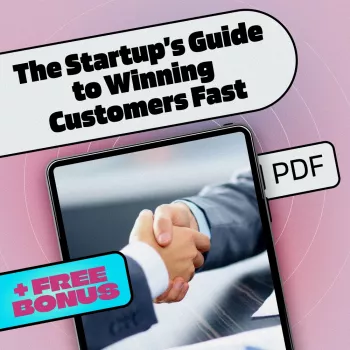
Product spotlight: The Startup’s Guide to Winning Customers Fast (digital download)
The Startup’s Guide to Winning Customers Fast (Digital Download) is an eBook designed for entrepreneurs who need a repeatable customer acquisition routine—especially in the messy early stage where time and budget are tight.
If you’re also exploring a smaller, faster way to generate income while testing a startup idea, Top 50 Side Hustles That Actually Pay (Digital Download PDF eBook) can help you shortlist realistic options without endless research.
FAQ
How fast can a startup realistically gain its first customers?
With a clear niche, a concrete offer, and consistent outreach, first qualified conversations can happen in days and early closes often land within a few weeks. Speed improves dramatically when follow-up is systematic and you keep tightening the message based on real replies.
Is outbound outreach still effective for early-stage customer acquisition?
Yes—targeted outbound can work extremely well when the list is curated, the message is specific, and the next step is a clear micro-commitment (like a fit check or pilot). The difference maker is follow-up cadence: many positive replies come after multiple touches.
What should be prepared before running a traction sprint?
Have a defined ideal customer, a one-sentence promise, a simple booking flow (landing page + calendar), a basic tracking sheet or CRM, and a clear offer or pilot structure. That’s enough to run fast tests and make confident cut/keep decisions.









Leave a comment