Cat Body Language Cheat Sheet: Tails, Ears & Meows
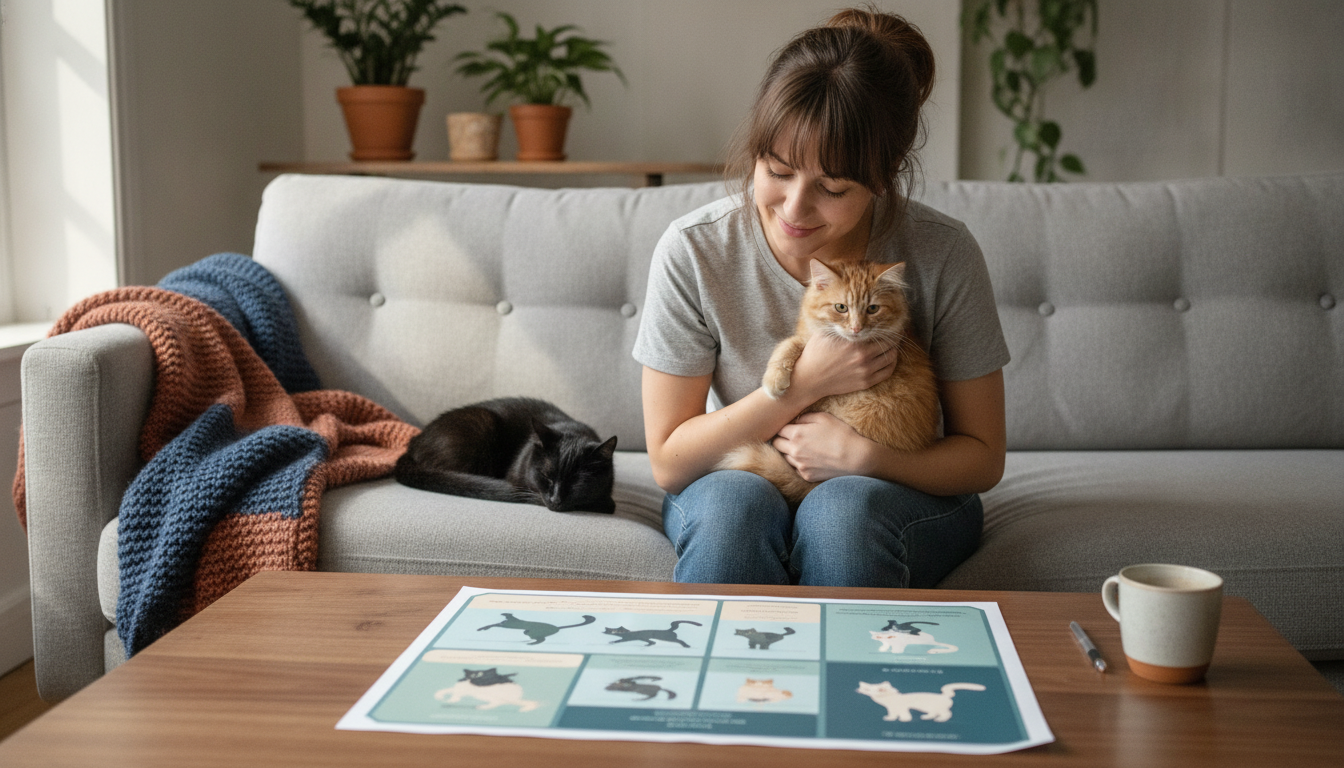
Cat Body Language & Behavior Cheat Sheet: A Practical Guide to Feline Signals, Postures, and Meows
Cats communicate constantly through tail position, ear angle, eye shape, posture, and voice. Learning to read these signals helps prevent bites and scratches, reduces stress in multi-cat homes, and builds trust. Use the guide below as a quick reference, then confirm meaning by looking at the full context picture: the environment, what happened right before, and your cat’s normal baseline.
How to read cat communication without guessing
- Look for clusters. One signal (like a swishing tail) can mean different things depending on ears, eyes, whiskers, and body tension.
- Compare to baseline. Shy cats, confident cats, and seniors may show the same emotion with different intensity.
- Track the timeline. A cat can move from curious → overstimulated → defensive in seconds during petting or play.
- Respect distance. If the cat increases distance or blocks contact (turns away, moves behind furniture), treat it as a clear message.
For deeper behavior context and welfare-centered guidance, resources like International Cat Care and the ASPCA cat care library can help confirm what you’re seeing at home.
Tail signals: what the “mood barometer” is really saying
- Upright tail: Friendly or confident approach; a quivering tip can indicate excitement (often a greeting).
- Low tail or tucked tail: Uncertainty, fear, or discomfort—especially if paired with crouching.
- Puffed tail: High arousal (fear or alarm); give space and reduce triggers.
- Lashing or thumping tail: Agitation or overstimulation; stop petting or end the interaction before escalation.
- Slow, relaxed tail movement: Focused interest (watching a toy, bird, or another cat) rather than irritation.
Quick cat body language cheat sheet (signals and likely meanings)
| Signal | Common meaning | Best response |
|---|---|---|
| Tail upright with a soft curve | Friendly, confident | Offer a calm greeting; let the cat initiate contact |
| Tail puffed (bottlebrush) | Alarmed or scared | Increase distance; remove stressor; avoid reaching in |
| Tail lashing or thumping | Overstimulated, irritated | Pause touch/play; give a short break |
| Ears forward | Curious, engaged | Proceed gently; reinforce calm with treats or slow play |
| Ears sideways (airplane ears) | Uncertain, conflicted | Reduce pressure; speak softly; allow retreat |
| Ears flattened back | Defensive or fearful | Stop interaction; do not corner; give a safe exit |
| Slow blink | Relaxed, affiliative | Slow blink back; keep movements soft and predictable |
| Dilated pupils with tense body | High arousal (fear or play) | Assess context; avoid sudden touch; redirect with a toy if playful |
| Crouched body, weight low | Fearful, ready to flee | Decrease noise; give space; provide hiding spot |
| Loose body, side-lying | Relaxed, comfortable | Gentle interaction; avoid overstimulating belly contact |
| Purring with stiff body | Can be stress or pain (not always happy) | Check for other signs; consider a vet consult if unusual |
| Hissing/growling | Clear warning | Back off immediately; end contact and reduce triggers |
Ears, eyes, and whiskers: the face tells the truth
- Ears forward and swiveling: Interest; your cat is gathering information and feels safe enough to investigate.
- Ears to the side: Uncertainty; your cat may be weighing whether to engage or retreat.
- Ears pinned back: Defensive fear or anger; avoid touching and provide a clear escape route.
- Soft eyes and slow blinks: Comfort and trust; respond with slow blinks and a calm voice.
- Hard stare: Tension or challenge (often between cats); break eye contact and redirect attention.
- Whiskers forward: Focused curiosity (prey/play mode) or interest in food.
- Whiskers pinned back against cheeks: Stress, discomfort, or defensiveness.
A helpful rule: the more “rounded and soft” the face looks (soft eyes, neutral whiskers, relaxed brow), the safer it is to interact. The more “tight and sharp” it looks (wide eyes, pinned ears, compressed whiskers), the more urgent it is to reduce pressure.
Posture and movement: relaxed, conflicted, or ready to defend
- Relaxed: Loose muscles, normal breathing, resting in open areas, grooming calmly.
- Conflicted: Approaching then stopping, sniffing then backing up, ears partly sideways, tail tip flicking.
- Defensive fear: Crouched low, leaning away, ears back, puffed tail; may swat if pressured.
- Offensive threat: Tall, stiff legs, forward lean, direct stare, growl; more common in cat-to-cat conflicts.
- Freeze response: The cat becomes statue-still; treat this as a serious warning that a bolt or strike may follow.
If your cat freezes during petting, pause immediately and let them reset. Freezing is often the moment right before “enough” turns into a bite.
Meows and vocalizations: what sounds can (and can’t) tell you
Common situations and what to do next
Printable reference for faster learning
If you want a ready-to-print version for the fridge or a pet-sitter folder, see the internal guide here: Cat Body Language & Behavior Cheat Sheet (printable guide).
For busy households, pairing behavior tracking with simple routines can help too. If you’re building steadier day-to-day habits, this downloadable resource can support consistency: Healthy Meal Plan & Recipe Collection (digital download).
FAQ
Does purring always mean a cat is happy?
No. Purring often signals contentment, but some cats also purr when stressed, in pain, or self-soothing. Check the full body picture (posture, ears, appetite, hiding, behavior changes) and contact a veterinarian if the purring is new and paired with other concerning signs.
Why does my cat swish their tail when I pet them?
Tail swishing during petting commonly means arousal is rising and overstimulation is building. Watch for ears turning back, skin twitching, or a tense body, and end the session as soon as tail lashing starts—shorter petting sessions and consent-based pauses help.
What are the clearest signs a cat wants to be left alone?
Hissing or growling, ears pinned back, a stiff or frozen body, tail lashing, and moving away or hiding are clear “no thanks” signals. Give space, avoid forced handling, and make sure your cat has an easy exit route.












Leave a comment